Bedtime Hand-to-Face Habits When You Are Tired or Scrolling
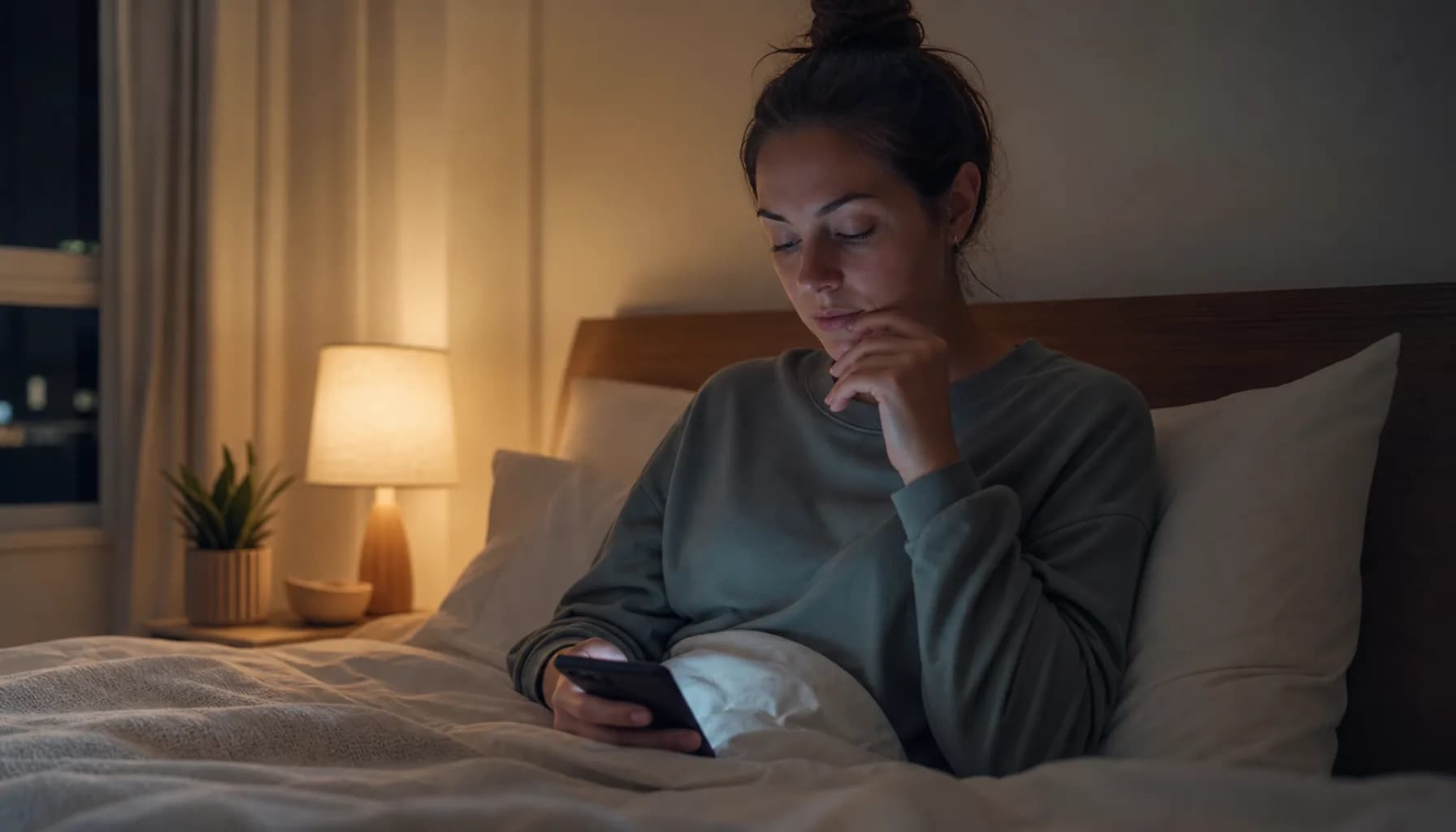
You are in bed, the room is finally quiet, and your phone is still in your hand.
At first you are just checking one message. Then you are scrolling. Your shoulders soften, your eyes feel heavy, and one hand drifts toward your chin, lips, nose, cheek, eyelashes, beard, or a rough patch of skin before you fully notice it.
Bedtime hand-to-face habits are frustrating because they often happen in the least structured part of the day. You are tired. The lights are low. Your attention is split between screen and urge. You may not be trying to pick, rub, bite, pull, or touch anything. Your hand simply keeps returning.
This guide is for that window: tired, in bed or on the couch, with a phone nearby. It is not a medical treatment plan. It is an awareness plan for noticing before autopilot takes over.
Why bedtime can make hand-to-face habits harder to catch
During the day, you may have more structure around you: a desk, meetings, a keyboard, other people, scheduled breaks. At night, many of those boundaries disappear.
The same behavior can feel different at bedtime because:
- your hands are free
- the phone keeps one hand active and the other hand idle
- low light makes small skin or hair cues harder to inspect accurately
- tiredness makes it easier to continue a routine without checking in
- scrolling gives your attention a steady stream of tiny distractions
That does not mean the behavior is your fault. The setting is doing a lot of the work.
Mayo Clinic sleep guidance recommends a quiet bedtime routine and avoiding extended screen use just before bed because screen light can disrupt sleep (Mayo Clinic). Mayo Clinic also notes that a cool, dark, quiet room and limiting light-emitting screens before bedtime can support better sleep habits (Mayo Clinic).
For hand-to-face habits, the sleep advice has a second practical benefit: a calmer, less phone-heavy wind-down routine gives your hands fewer chances to drift toward your face unnoticed.
What counts as a bedtime hand-to-face habit?
This article is about repeated hand movement toward the face during the evening wind-down window: resting fingers on your lips, rubbing tired eyes, touching your nose, checking rough lip skin, picking at a spot, pulling facial hair, or holding your chin for long stretches.
Not every touch is a problem. Sometimes you need to scratch an itch, remove an eyelash, apply lip balm, or wash your face.
The pattern becomes worth addressing when it is repeated, automatic, physically irritating, hard to interrupt, or distressing. Cleveland Clinic describes body-focused repetitive behaviors as repetitive self-grooming actions such as skin picking, hair pulling, nail biting, lip biting, and cheek biting that can become hard to stop for some people (Cleveland Clinic).
This does not mean you have a disorder. It means the behavior belongs to a family of patterns where awareness, triggers, replacement actions, and professional support can matter.
Why scrolling changes the habit loop
Scrolling changes the rhythm of the moment. Your eyes stay busy, one thumb keeps moving, and the rest of the body becomes background noise. That is exactly when a hand-to-face loop can hide.
The cue might be tiny:
- a dry spot on your lip
- an itchy nose
- eye fatigue
- a beard hair that feels different
- a pimple you noticed earlier
- jaw tension after the day
- boredom during one more scroll
Then the behavior gives a small, immediate sensation: pressure, smoothing, checking, pulling, scratching, or brief relief. Because the phone keeps feeding your attention, the loop can repeat without a clean stopping point.
The goal is not to ban your phone forever. The goal is to make the high-risk part of the routine visible enough that you can choose a different response.
A practical bedtime reset plan
Step 1: Choose one "phone-off face-safe" moment
Do not start with an idealized two-hour digital detox if that is not your real life.
Pick one small boundary:
- no scrolling once you are lying flat
- phone charges across the room after the first alarm is set
- last 10 minutes in bed are audio only
- no social apps after brushing teeth
- if your hand touches your face twice, the phone goes on the nightstand
The rule should be simple enough to remember when you are tired.
The American Academy of Sleep Medicine includes excessive screen time right before bed and stimulating activities at night among barriers to sleep that clinicians may help patients identify and reduce (AASM). For this article's purpose, reducing bedtime scrolling is not framed as treatment. It is a way to reduce one common trigger window.
Step 2: Give your idle hand a default position
Most bedtime hand-to-face habits start with an unassigned hand.
Choose a default:
- both hands under the blanket
- phone in both hands while sitting up
- free hand flat on your thigh
- free hand holding a soft cloth, book, or pillow edge
This sounds almost too small, but it changes the first movement. Instead of hand drifting upward by default, it has a place to return to.
Step 3: Build a one-minute replacement response
Cleveland Clinic describes habit reversal training as a behavioral therapy that uses awareness training and competing response training, where the replacement behavior makes the unwanted behavior difficult to complete and can be sustained briefly (Cleveland Clinic).
You do not need to run therapy on yourself. But you can borrow the practical idea: when the hand starts moving toward the face, do one neutral action instead.
Try one:
- press both palms gently into the blanket for 30 to 60 seconds
- hold the phone with both hands and keep elbows resting on the bed
- fold hands under the pillow for one slow breath
- hold a soft object in the hand that usually reaches up
- put both feet on the floor, sit up, and reset the room for sleep
Pick one response. Repetition matters more than variety.
Step 4: Reduce sensory triggers before bed
Many evening loops start with a real sensation: dryness, itch, tension, or uneven texture.
Before getting into bed, run a short "reduce the cue" routine:
- wash or clean hands if you have been out, cooking, commuting, or using shared surfaces
- use a plain lip moisturizer if lip dryness is a trigger
- tie back hair or use a soft headband if strands near the face invite touching
- place tissues near the bed so nose or eye contact does not require bare fingers
- keep nails trimmed if picking or scratching tends to escalate
CDC facial hygiene guidance notes that germs on unwashed hands can enter through the nose, eyes, and mouth when you touch your face (CDC). That does not mean every touch will make you sick. It means clean hands and fewer unnecessary touches are reasonable, low-risk habits.
Step 5: Change the posture, not your personality
Some bedtime routines invite face touching: lying on one side with the phone near your face, propping your chin on your hand, scrolling in darkness, or lying flat while trying to stay awake.
Change the setup instead. Sit upright for phone use, keep the phone below chest level, use a small lamp while winding down, or place a pillow over your lap so both hands have a resting surface.
You are not trying to become more disciplined at 11:45 p.m. You are making the old movement slightly less convenient.
Where Leave Your Face Alone (LYFA) fits
Leave Your Face Alone (LYFA) is not a treatment, medical device, or sleep intervention. It is a supportive awareness tool for hand-to-face movement.
For bedtime-adjacent habits, LYFA can be useful earlier in the evening, especially during the screen-heavy wind-down before sleep. It uses webcam-based AI detection to notice when hands approach the face and can provide real-time alerts. Detection runs locally on the device, and raw webcam footage is not transmitted to Leave Your Face Alone servers. You can also review habit statistics later.
That makes LYFA most relevant for the part of the routine when you are still at your laptop or sitting up with a device, not for moments when you are asleep or should be trying to sleep. Used modestly, it can help you learn your high-risk evening window: after work, during streaming, while scrolling, or when fatigue starts to show up in your hands.
The product angle is simple: if you can notice the hand rising earlier, you have a better chance to choose your replacement response.
A simple 7-night experiment
For one week, keep the plan light.
On nights 1 and 2, observe only where you were, what you were doing, and where your hand went. Do not score yourself.
On nights 3 and 4, add one phone boundary: no scrolling lying flat, phone away after brushing teeth, or audio only for the last 10 minutes.
On nights 5 and 6, use one replacement response every time the hand rises: palms into the blanket, both hands around the phone, hands under the pillow, or a soft object in the free hand.
On night 7, review without blame. Which situation created the most movement? Which cue showed up first? Which replacement response was easiest when tired? Keep the smallest useful change for next week.
When to get extra support
Consider talking with a qualified healthcare professional if the behavior causes bleeding, wounds, infection concerns, hair loss, skin damage, significant distress, shame, or interference with daily life.
If the habit feels compulsive, painful, or very hard to interrupt, it deserves support. A clinician can help distinguish an everyday habit from a more significant BFRB pattern and discuss appropriate options.
Final takeaway
Bedtime hand-to-face habits are not just a willpower problem. They often sit at the intersection of tiredness, privacy, phone scrolling, sensory cues, and a lack of structure.
Start small:
- give the phone a boundary
- give the idle hand a home
- reduce the strongest sensory cue
- use one replacement response
- review weekly, not obsessively
The goal is not a perfect night. The goal is one earlier catch, repeated often enough that bedtime becomes a little less automatic.
Disclaimer: This article is for general informational purposes only and is not medical or mental-health advice, diagnosis, or treatment. Leave Your Face Alone is a supportive awareness tool, not a treatment or medical device, and it is not a replacement for medical care, dermatology care, therapy, or sleep care. If hand-to-face behavior causes distress, injury, skin damage, bleeding, infection concerns, hair loss, pain, or interferes with daily life, speak with a qualified healthcare professional.
Related Articles

How to Stop Picking the Skin Around Your Ears
If your hand keeps returning to rough skin, tiny scabs, or dry spots around your ears, this guide helps you notice the hand-to-ear loop earlier and respond more gently.

How to Stop Touching Your Eyebrows While Working
If your hand keeps drifting to your eyebrows during focus work, this guide helps you separate useful grooming from autopilot and notice the movement earlier.
Ready to notice hand-to-face moments earlier?
Leave Your Face Alone gives you a gentle nudge when your hand moves toward your face, so you can interrupt the impulse in the moment and make your progress visible.