How to Stop Biting the Skin Around Your Nails: A Practical Guide with Leave Your Face Alone
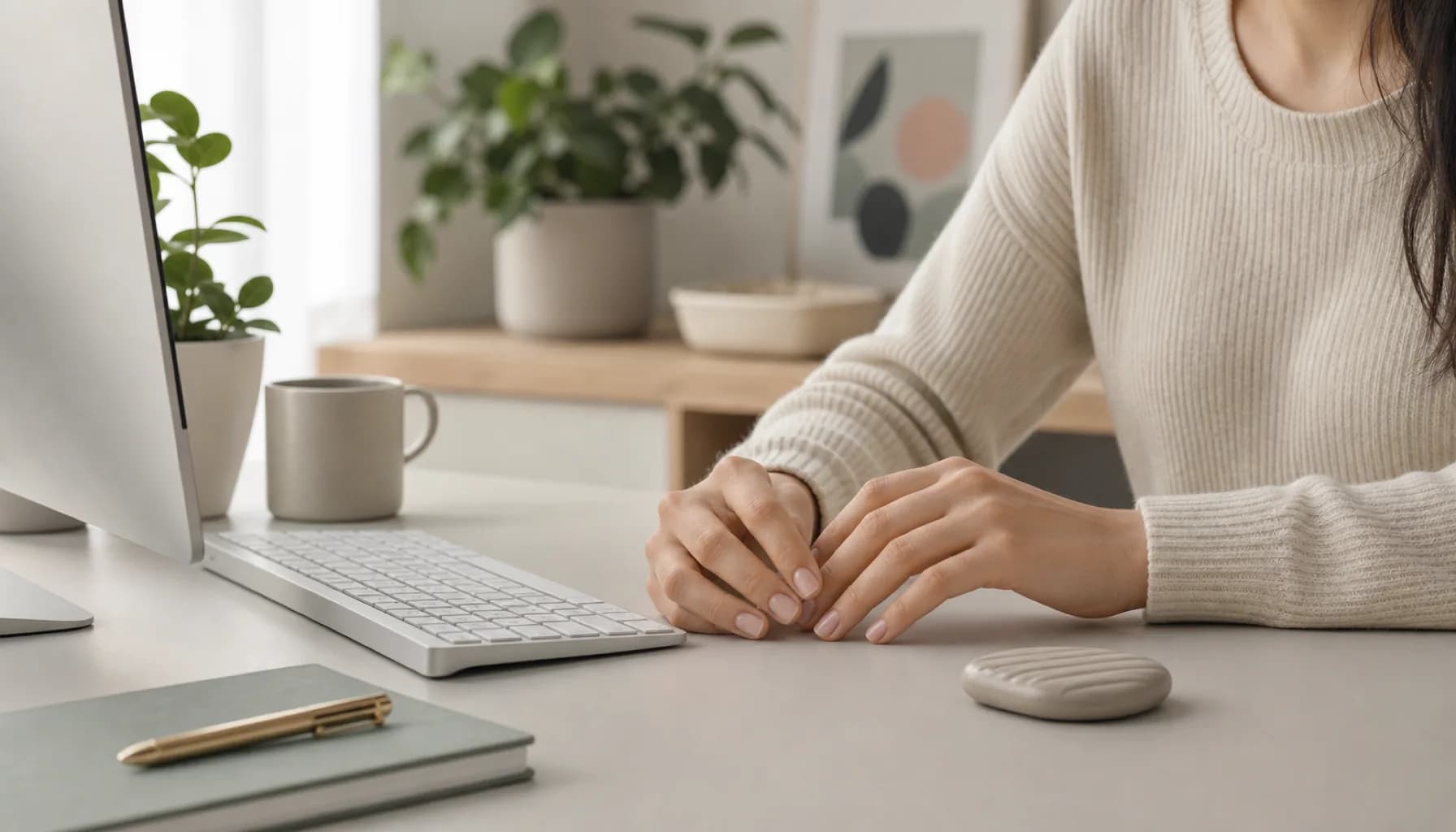
You are reading something on your laptop, one hand near the keyboard, and your thumb is already at your mouth before you fully notice.
Maybe it starts with a tiny hangnail. Maybe the skin beside one nail feels rough. Maybe you only do it when you are thinking hard, waiting for a page to load, or sitting through a long meeting.
If you keep biting the skin around your nails, chewing your cuticles, or picking at rough fingertip skin during work or study, the goal is not to shame yourself into stopping. The goal is to make the early part of the loop easier to notice, reduce the triggers that keep pulling you back in, and choose a response you can actually repeat.
This guide focuses on skin around the nails, not the nail plate itself. If your main pattern is biting the nails, start with Why We Bite Our Nails While Working or Studying — And How to Stop or Overcoming Nail Biting: Understanding Why and How to Stop.
Is cuticle biting the same as nail biting?
They overlap, but they are not identical.
Nail biting usually focuses on the nail edge or nail plate. Skin-around-nails biting often focuses on the cuticle area, sidewalls, hangnails, or rough fingertip skin. Some people do both. Others barely bite the nail itself but repeatedly chew, tear, or "even out" the skin around it.
Cleveland Clinic describes body-focused repetitive behaviors (BFRBs) as repetitive self-grooming behaviors that can include nail biting, skin biting, nail picking, and skin picking. These behaviors can happen with awareness or on autopilot, and some people find them hard to stop once the urge starts (Cleveland Clinic).
That does not mean every cuticle-biting habit is a disorder. It does mean the behavior often deserves a practical system, especially when it causes soreness, bleeding, visible damage, distress, or a sense that you are not fully in control.
Why the skin around your nails becomes such an easy target
The skin around the nails creates a strong sensory loop. A small raised edge catches your attention. Your teeth or fingers try to smooth it. For a few seconds, the area feels "fixed." Later, the skin is more irritated, which creates a new rough edge.
The loop can be especially sticky because it combines several cues:
- Texture: a hangnail, dry edge, or uneven cuticle gives your attention something specific to scan.
- Access: your hands are already visible and available while typing, reading, or scrolling.
- Focus drift: during deep work, part of your attention stays on the task while your hand moves automatically.
- Short relief: the bite or pick may briefly reduce tension or satisfy the urge to make the skin feel even.
The American Academy of Dermatology advises people not to bite fingernails or remove the cuticle because doing so can damage the nail area (AAD). For this article, the practical takeaway is simple: reducing repeated biting and tearing is worth taking seriously, even if the habit feels small.
Common trigger windows to map first
Do not start with a huge tracking spreadsheet. Start with the moments when the behavior actually shows up.
For three days, note only:
- when it happened
- what you were doing
- what the first cue was
- whether it was biting, picking, scanning, or "fixing"
Common patterns include:
Desk focus
This is the classic work-and-study pattern. You are reading, coding, editing, or solving a problem. One hand pauses, finds a rough spot, and moves toward your mouth.
Waiting moments
Loading screens, video-call pauses, build times, slow replies, and task switching can create just enough idle time for the habit to start.
Stress before communication
Some people notice more skin biting before calls, presentations, difficult messages, or review meetings.
Dryness and snags
Cold weather, frequent hand washing, cleaning products, and dry indoor air can make the skin around the nails feel rougher. That does not cause every episode, but it can raise the trigger load.
Evening fatigue
At the end of the day, the same plan that felt easy at noon may feel harder to use. Fatigue matters.
A practical plan to stop biting the skin around your nails
The goal is not perfection. The goal is to catch more starts earlier than last week.
Step 1: Lower the physical trigger load
If the skin around your nails is constantly rough, your brain will keep finding a target.
Try a basic, low-friction routine:
- keep nails trimmed and filed so there are fewer sharp edges
- use a simple hand cream after washing your hands
- keep a small nail file or clipper nearby for snags
- avoid tearing hangnails with your teeth
- use a tissue or tool when you need to deal with a rough edge
This is not a medical treatment plan. It is a way to reduce the number of sensory cues that invite checking and biting.
Step 2: Separate "checking" from "biting"
Many episodes begin before the actual bite. The earlier behavior may be scanning.
Watch for these early signals:
- rubbing your thumb along another fingertip
- lifting your hand toward your mouth while reading
- pressing a rough edge with your teeth without biting yet
- visually checking one finger again and again
If you can interrupt checking, you often do not have to fight the full urge later.
Step 3: Choose one competing response
Habit reversal training is a behavioral approach that often uses awareness plus an alternative action. Cleveland Clinic describes it as a therapy that replaces an unwanted behavior with another response, commonly with professional guidance (Cleveland Clinic).
For a self-help awareness plan, keep the replacement simple:
- press both palms flat on your thighs for 30 seconds
- hold a smooth stone, pen, or fidget object
- clasp your hands loosely under the desk
- put both feet on the floor and take one slow exhale
- pick up a mug with both hands for one minute
Choose one. A single repeatable response beats five clever options you never use.
Step 4: Make a small "repair station"
If the urge is driven by a real snag, ignoring it may not work. Create a neutral repair option instead.
Keep these in one visible place:
- nail file
- small clipper
- plain hand cream
- bandage for a painful spot
The rule is: no teeth, no tearing, no desk-side surgery. If a snag needs attention, use the tool once, then return to the task.
Step 5: Build friction into high-risk work blocks
You do not need to redesign your whole life. Change the two windows where the habit is strongest.
Examples:
- during reading, keep a pen in your dominant hand
- during meetings, keep both hands visible on the desk
- during waiting moments, stand up or stretch for 20 seconds
- during deep work, use a fidget object only for that session
- before video calls, apply hand cream so rough edges are less distracting
Make the replacement action easier to start than the old action.
Step 6: Review weekly, not constantly
Constant self-monitoring can become stressful. Weekly review is enough.
Ask:
- Which trigger showed up most?
- Did I catch any hand-to-mouth movement earlier?
- Which replacement response was easiest?
- What made the old pattern more likely?
Keep one useful change. Drop one that felt unrealistic.
Where Leave Your Face Alone (LYFA) fits
Leave Your Face Alone (LYFA) is not a treatment for nail biting, skin biting, dermatophagia, dermatillomania, anxiety, OCD, or any medical or mental-health condition. It is a supportive awareness tool.
For skin-around-nails biting, LYFA is most relevant when the behavior involves hand-to-mouth movement. It can support your plan by using:
- webcam-based AI detection
- real-time alerts when hands approach the face
- local detection on your device
- no transmission of raw webcam footage to LYFA servers
- habit statistics you can review later
The useful moment is often early: your hand starts moving up, but the bite has not happened yet. A gentle alert may help you notice that transition and switch to your competing response.
LYFA will not detect every form of cuticle picking, especially if both hands stay below your face. It works best as one awareness layer inside a broader plan: trigger reduction, replacement responses, and professional support when needed.
When to seek professional support
Consider talking with a qualified healthcare professional if the behavior causes regular bleeding, skin damage, pain, infection concerns, significant distress, or interference with daily life.
You should also seek medical care if the nail area becomes swollen, painful, warm, or drains pus, or if a wound does not seem to heal. Cleveland Clinic notes that repeated biting, picking, or pulling can lead to complications such as infections or open wounds in some BFRB patterns (Cleveland Clinic).
If the behavior feels compulsive, a clinician can help you understand whether it is part of a broader BFRB pattern and discuss evidence-based options that fit your situation.
A realistic 7-day starter plan
Day 1-2: Observe
Track your top two trigger windows. Do not try to fix everything yet.
Day 3: Reduce snags
Trim or file sharp edges. Put hand cream, a file, and a simple replacement object near your desk.
Day 4-5: Interrupt early
When your hand starts moving toward your mouth, use your one competing response for 30 seconds.
Day 6: Add one work-block rule
Example: "During reading, I hold a pen." Keep it visible.
Day 7: Review
Look for early catches, not perfect days. Decide what to keep next week.
Final takeaway
If you want to stop biting the skin around your nails, start earlier than the bite.
Map the trigger windows. Lower the number of rough edges. Interrupt checking. Choose one replacement action. Use Leave Your Face Alone as a modest awareness tool when the behavior includes hand-to-mouth movement.
This is not about perfect hands or perfect self-control. It is about building a repeatable system that gives you more chances to notice the loop before it runs on autopilot.
Disclaimer: This article is for general informational purposes only and is not medical advice, diagnosis, treatment, or mental-health advice. Leave Your Face Alone is a supportive awareness tool, not a treatment or medical device. If biting or picking around your nails causes distress, injury, skin damage, bleeding, infection concerns, or interferes with daily life, speak with a qualified healthcare professional.
Related Articles

How to Stop Touching Your Eyebrows While Working
If your hand keeps drifting to your eyebrows during focus work, this guide helps you separate useful grooming from autopilot and notice the movement earlier.

How to Stop Adjusting Your Glasses and Touching Your Face While Working
If pushing your glasses back into place keeps turning into face touching, this guide helps you separate real fit problems from autopilot and build a practical awareness plan.
Ready to notice hand-to-face moments earlier?
Leave Your Face Alone gives you a gentle nudge when your hand moves toward your face, so you can interrupt the impulse in the moment and make your progress visible.